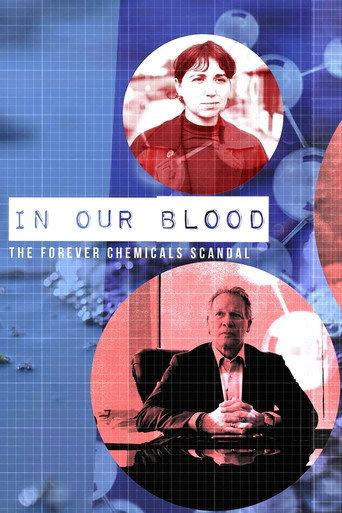
In Our Blood: The Forever Chemicals Scandal poster
Movie

In Our Blood: The Forever Chemicals Scandal

2026

52Score
Slightly Woke

A few message-driven moments appear.

My list →Saved on this device — no account required.
Share this verdict card

Is In Our Blood: The Forever Chemicals Scandal Woke? Quick Answer

In Our Blood: The Forever Chemicals Scandal scores 52/100 on the IsItWoke scale and is rated Slightly Woke.

You get some message-forward moments, and story still has to carry the film.

The documentary relies heavily on message-driven narration and interviews that emphasize environmental activism and corporate malfeasance, often prioritizing moral lecturing over nuanced storytelling. Characters, mostly real residents and workers, are portrayed with some depth but occasionally serve as symbolic victims to underscore the toxic chemical scandal, creating a slight tokenistic effect.

See the full breakdown below.

Signal profile

What is driving this verdict

Messaging

Political messaging: Medium

These are structured scoring signals, not standalone factual claims. Read them together with the source-backed receipts and full analysis below.

Woke profile

How the score is shaped

Eight stored dimensions, each scored from 0 to 20.

  • Message-first dialogue

    12/20
  • Tokenistic characters

    2/20
  • Ideology over story

    14/20
  • Legacy rewriting

    0/20
  • Modern politics injection

    10/20
  • Protected protagonist pattern

    3/20
  • Anti-traditional framing

    5/20
  • Cultural normalization framing

    8/20

AI vs Community

AI says Slightly Woke. What do users say?

AI verdict: Slightly Woke. Be among the first to challenge it.

Community verdict

Pick the band you think fits. One vote per browser on this title. You cannot change it after you vote.

Loading community votes…

Why it received this score

Based on: Published title analysisConfidence: MediumLast updated: 2026-10-12

Key reasons

  • The documentary relies heavily on message-driven narration and interviews that emphasize environmental activism and corporate malfeasance, often prioritizing moral lecturing over nuanced storytelling.
  • Characters, mostly real residents and workers, are portrayed with some depth but occasionally serve as symbolic victims to underscore the toxic chemical scandal, creating a slight tokenistic effect.
  • The overall narrative prioritizes ideological framing about environmental justice and corporate accountability, sometimes at the expense of pacing and immersive storytelling.
View full breakdown
  • There is no legacy property or adaptation involved, so legacy rewriting is not applicable here.
  • Contemporary political discourse around environmental regulation and corporate responsibility is strongly injected, which may feel immersion-breaking for viewers seeking a purely factual account.
  • The protagonists are real people affected by the scandal, and while they face genuine consequences, the film occasionally frames them as emblematic heroes of a larger cause, slightly elevating them beyond ordinary vulnerability.

Score signals

SignalWhat was measuredStrengthImpact
Ideology over storyHow much the overall storytelling prioritizes ideological framing, message delivery, social commentary, or activism-coded narrative choices over pacing, conflict, immersion, and entertainment.14/20+10
Message-first dialogueHow much the dialogue, monologues, or character interactions feel driven by overt messaging, moral lecturing, ideological framing, or making a point instead of serving the story naturally.12/20+8
Modern politics injectionHow much contemporary political discourse, activist framing, or modern culture-war signaling appears injected into fantasy, sci-fi, historical, or otherwise escapist settings in a way that feels noticeable or immersion-breaking.10/20+6
Cultural normalization framingHow much the title repeatedly frames a specific social model, identity/sexuality framing, lifestyle, family structure, or set of values as culturally meaningful, normalizing, morally instructive, or aspirational. Increase score when the work itself is explicitly positioned around that cultural proposition - through narrative, marketing, advocacy, or identity-specific educational/sexual content. Mere presence of any demographic or an incidental relationship is not enough.8/20+5
Anti-traditional framingHow strongly a title normalizes, glamorizes, or positively frames anti-traditional, anti-religious, anti-family, or civilizationally subversive themes in a way that should count as woke or corrosive for this product's audience.5/20+3

AI cultural analysis

A short read on tone, themes, and messaging — not a plot synopsis.

AI read

In Our Blood: The Forever Chemicals Scandal is a documentary that clearly prioritizes environmental and social justice messaging. Its narrative is driven by a strong ideological agenda focused on exposing corporate wrongdoing and advocating for stricter chemical regulations.

This message-first approach sometimes overshadows the storytelling, making the film feel more like a moral indictment than an immersive documentary experience. The real-life characters, while authentic, occasionally function more as symbols of victimhood than fully rounded individuals, which introduces a modest degree of tokenism.

Related titles

More like this.

People also checked

What others ran after this one.

Run In Our Blood: The Forever Chemicals Scandal through another test

Explore

Trending now

Send feedback

We send your description, report type, optional email and the current page path. No browsing history or session transcript is included.