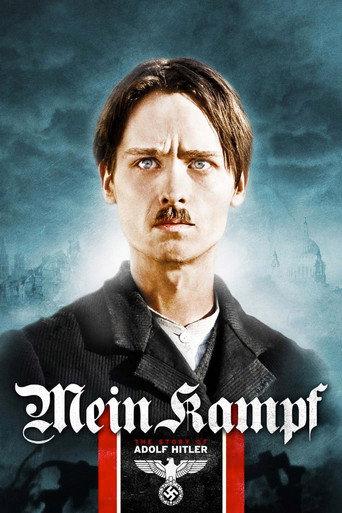
Mein Kampf poster
Movie

Mein Kampf

2009

83Score
Certified Woke Trash

Messaging overwhelms the narrative.

My list →Saved on this device — no account required.
Share this verdict card

Is Mein Kampf Woke? Quick Answer

Mein Kampf scores 83/100 on the IsItWoke scale and is rated Certified Woke Trash.

The messaging is doing a lot of the work in this film.

The film uses dialogue and interactions heavily loaded with ideological framing, often prioritizing the messaging about Hitler's early life and the dangers of his ideology over natural storytelling. Characters, especially the Jewish writer Schlomo Herzl, appear somewhat tokenistic, serving as symbolic foils to Hitler rather than fully developed individuals with organic narrative roles.

See the full breakdown below.

Signal profile

What is driving this verdict

Messaging

Political messaging: High

Narrative focus

Identity / sexuality centrality: Medium

These are structured scoring signals, not standalone factual claims. Read them together with the source-backed receipts and full analysis below.

Woke profile

How the score is shaped

Eight stored dimensions, each scored from 0 to 20.

  • Message-first dialogue

    12/20
  • Tokenistic characters

    8/20
  • Ideology over story

    14/20
  • Legacy rewriting

    10/20
  • Modern politics injection

    6/20
  • Protected protagonist pattern

    5/20
  • Anti-traditional framing

    7/20
  • Cultural normalization framing

    9/20

AI vs Community

Community verdict is still forming.

3 votes so far. We publish a community verdict after 5; 2 more needed.

Community verdict

Pick the band you think fits. One vote per browser on this title. You cannot change it after you vote.

Loading community votes…

Why it received this score

Based on: Published title analysisConfidence: MediumLast updated: 2026-10-12

Key reasons

  • The film uses dialogue and interactions heavily loaded with ideological framing, often prioritizing the messaging about Hitler's early life and the dangers of his ideology over natural storytelling.
  • Characters, especially the Jewish writer Schlomo Herzl, appear somewhat tokenistic, serving as symbolic foils to Hitler rather than fully developed individuals with organic narrative roles.
  • The narrative prioritizes a reinterpretation of Hitler's origins with a strong ideological agenda, reshaping historical events to fit a modern cautionary tale, which overshadows entertainment and pacing.
View full breakdown
  • This movie significantly rewrites legacy material by fictionalizing and dramatizing Hitler's early years in a way that feels driven by contemporary ideological concerns rather than historical fidelity.
  • The film injects modern political discourse into a historical setting, making the story feel at times immersion-breaking and more like a cultural warning than a balanced drama.

Score signals

SignalWhat was measuredStrengthImpact
Ideology over storyHow much the overall storytelling prioritizes ideological framing, message delivery, social commentary, or activism-coded narrative choices over pacing, conflict, immersion, and entertainment.14/20+10
Message-first dialogueHow much the dialogue, monologues, or character interactions feel driven by overt messaging, moral lecturing, ideological framing, or making a point instead of serving the story naturally.12/20+8
Legacy rewritingHow much an existing franchise, adaptation, setting, or known property appears significantly altered, reinterpreted, or re-centered in ways that feel driven by modern ideological priorities rather than faithful or organic storytelling.10/20+6
Tokenistic charactersHow much characters feel inserted or shaped primarily for symbolic representation, political signaling, or demographic checkbox value rather than narrative depth, organic fit, or strong characterization.8/20+5
Cultural normalization framingHow much the title repeatedly frames a specific social model, identity/sexuality framing, lifestyle, family structure, or set of values as culturally meaningful, normalizing, morally instructive, or aspirational. Increase score when the work itself is explicitly positioned around that cultural proposition - through narrative, marketing, advocacy, or identity-specific educational/sexual content. Mere presence of any demographic or an incidental relationship is not enough.9/20+5

AI cultural analysis

A short read on tone, themes, and messaging — not a plot synopsis.

AI read

Mein Kampf (2009) leans heavily into ideological storytelling, focusing on a message-first approach that frames Hitler's early life as a cautionary tale. The dialogue often feels like moral lecturing, prioritizing ideological points over natural character development or plot momentum.

The character of Schlomo Herzl functions more as a symbolic counterpoint to Hitler than as a fully fleshed-out person, which contributes to a sense of tokenism. The film's narrative choices rewrite historical legacy with a clear modern political lens, reshaping events to serve a contemporary ideological warning.
Related titles

More like this.

People also checked

What others ran after this one.

Run Mein Kampf through another test

Explore

Trending now

Send feedback

We send your description, report type, optional email and the current page path. No browsing history or session transcript is included.