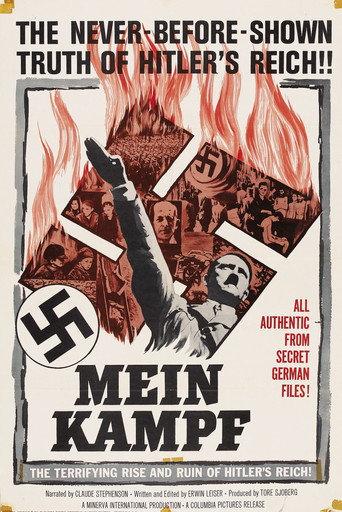
Mein Kampf poster
Movie

Mein Kampf

1960

11Score
Absolute Cinema

Story over sermons. Cinema first.

My list →Saved on this device — no account required.
Share this verdict card

Is Mein Kampf Woke? Quick Answer

Mein Kampf scores 11/100 on the IsItWoke scale and is rated Absolute Cinema.

That is the story-first end of the scale for this film.

The film relies on archival footage to document historical events rather than crafting fictional dialogue, so message-first dialogue is minimal but present in the form of narration and propaganda excerpts. There is no insertion of tokenistic characters since the film is a documentary focused on real historical figures and events without fictionalization.

See the full breakdown below.

Woke profile

How the score is shaped

Eight stored dimensions, each scored from 0 to 20.

  • Message-first dialogue

    5/20
  • Tokenistic characters

    0/20
  • Ideology over story

    6/20
  • Legacy rewriting

    0/20
  • Modern politics injection

    0/20
  • Protected protagonist pattern

    0/20
  • Anti-traditional framing

    0/20
  • Cultural normalization framing

    0/20

AI vs Community

AI says Absolute Cinema. What do users say?

AI verdict: Absolute Cinema. Be among the first to challenge it.

Community verdict

Pick the band you think fits. One vote per browser on this title. You cannot change it after you vote.

Loading community votes…

Why it received this score

Based on: Published title analysisConfidence: MediumLast updated: 2026-10-12

Key reasons

  • The film relies on archival footage to document historical events rather than crafting fictional dialogue, so message-first dialogue is minimal but present in the form of narration and propaganda excerpts.
  • There is no insertion of tokenistic characters since the film is a documentary focused on real historical figures and events without fictionalization.
  • The storytelling prioritizes exposing the ideology and propaganda of the Nazi regime, which inherently involves ideological framing but remains rooted in factual presentation rather than activism or modern political agendas.
View full breakdown
  • The film does not rewrite or reinterpret the legacy of the Third Reich but rather presents original propaganda material to confront its mechanisms and consequences.
  • No modern political discourse or culture-war framing is injected; the film is historically grounded and avoids contemporary ideological overlays.
  • The protagonist, Adolf Hitler, is presented through archival footage and propaganda without any narrative protection or competence fantasy; consequences and downfall are clearly depicted.

Score signals

SignalWhat was measuredStrengthImpact
Ideology over storyHow much the overall storytelling prioritizes ideological framing, message delivery, social commentary, or activism-coded narrative choices over pacing, conflict, immersion, and entertainment.6/20+4
Message-first dialogueHow much the dialogue, monologues, or character interactions feel driven by overt messaging, moral lecturing, ideological framing, or making a point instead of serving the story naturally.5/20+3

AI cultural analysis

A short read on tone, themes, and messaging — not a plot synopsis.

AI read

Mein Kampf (1960) is a documentary that uses archival footage to trace the rise and fall of the Third Reich, focusing on historical accuracy and original propaganda materials. Its narrative is driven by the factual presentation of events rather than fictional storytelling, which limits the presence of message-first dialogue to narration and the propaganda itself.

The film avoids inserting tokenistic characters or rewriting legacy, instead confronting the mechanisms of totalitarianism head-on. While ideological framing is inherent in exposing Nazi propaganda, the film does not prioritize modern political agendas or culture-war themes, maintaining historical context without contemporary injection.
Related titles

More like this.

People also checked

What others ran after this one.

Run Mein Kampf through another test

Explore

Trending now

Send feedback

We send your description, report type, optional email and the current page path. No browsing history or session transcript is included.