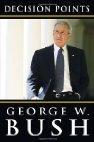
Decision Points poster
Book

Decision Points

44Score
Slightly Woke

A few message-driven moments appear.

My list →Saved on this device — no account required.
Share this verdict card

Is Decision Points Woke? Quick Answer

Decision Points scores 44/100 on the IsItWoke scale and reads as Slightly Woke.

You get some message-forward moments, and story still has to carry the book.

The book's dialogue and narrative strongly serve to justify and defend Bush's political decisions, making messaging a dominant force over natural storytelling. Characters other than Bush are portrayed mainly as instruments to highlight his leadership, lacking independent depth or complexity.

See the full breakdown below.

Signal profile

What is driving this verdict

Messaging

Political messaging: High

Character writing

Protected / consequence-free lead: High

These are structured scoring signals, not standalone factual claims. Read them together with the source-backed receipts and full analysis below.

Woke profile

How the score is shaped

Eight stored dimensions, each scored from 0 to 20.

  • Message-first dialogue

    12/20
  • Tokenistic characters

    15/20
  • Ideology over story

    14/20
  • Legacy rewriting

    0/20
  • Modern politics injection

    13/20
  • Protected protagonist pattern

    16/20
  • Anti-traditional framing

    0/20
  • Cultural normalization framing

    0/20

Receipts used in this verdict

Medium confidence

These source-linked claims were gathered before scoring. Supporting evidence can raise a relevant signal; counterevidence can reduce or contextualize it. Corporate statements, consultant credits and optional identity cosmetics are context for investigation. They do not establish narrative ideology or directly raise the score.

Reveal detailed receipts · may contain spoilers

The verdict above is spoiler-light. The concrete examples below can describe scenes, plot turns, character outcomes, or late-game material.

  • Tokenistic character writingsupporting

    Reviewers note that in Decision Points 'everybody but Bush exists, characterologically, as a figure in the drama of Bush, not as an independent figure under observation.' [2]

  • Ideology over storysupporting

    Critics state Bush 'constructs a theory of political leadership that valorizes decisiveness and by implication downgrades all other qualities one might want a head of state to possess,' indicating the book frames political virtue around an ideological proposition about leadership. [2]

  • Modern politicssupporting

    Publisher and book descriptions present Decision Points as Bush's account and defense of key contemporary presidential policies and actions (e.g., enhanced interrogations, the Terrorist Surveillance Program, Iraq surge, Katrina response), framing it as explicit commentary on recent political decisions. [1]

Research checked 2026-10-16

AI vs Community

Community verdict is still forming.

1 vote so far. We publish a community verdict after 5; 4 more needed.

Community verdict

Pick the band you think fits. One vote per browser on this title. You cannot change it after you vote.

Loading community votes…

Why it received this score

Based on: Published title analysisConfidence: MediumLast updated: 2026-10-16

Key reasons

  • The book's dialogue and narrative strongly serve to justify and defend Bush's political decisions, making messaging a dominant force over natural storytelling.
  • Characters other than Bush are portrayed mainly as instruments to highlight his leadership, lacking independent depth or complexity.
  • The memoir prioritizes an ideological framing of leadership that valorizes decisiveness above other qualities, shaping the story to fit this political thesis.
View full breakdown
  • Contemporary political controversies and policies are explicitly addressed, embedding modern political discourse directly into the narrative.
  • Bush is presented as a protected protagonist whose competence and moral stature are rarely questioned, with setbacks and vulnerabilities minimized or framed to reinforce his leadership image.

Score signals

SignalWhat was measuredStrengthImpact
Ideology over storyHow much the overall storytelling prioritizes ideological framing, message delivery, social commentary, or activism-coded narrative choices over pacing, conflict, immersion, and entertainment.14/20+10
Protected protagonist patternHow much the protagonist fits the protected-protagonist pattern (agenda-driven character construction) rather than competence fantasy. Score HIGH only when: competence appears unearned or unexplained; protagonist rarely faces consequences; antagonists exist mainly to demonstrate protagonist superiority; narrative treats protagonist as symbolically superior; plot shields protagonist from vulnerability. Score LOW when: competence is grounded in training, profession, or past experience; protagonist suffers damage or setbacks; real physical danger and survival tension exist (normal action storytelling). Do not penalize competence fantasy.16/20+10
Tokenistic charactersHow much characters feel inserted or shaped primarily for symbolic representation, political signaling, or demographic checkbox value rather than narrative depth, organic fit, or strong characterization.15/20+9
Message-first dialogueHow much the dialogue, monologues, or character interactions feel driven by overt messaging, moral lecturing, ideological framing, or making a point instead of serving the story naturally.12/20+8
Modern politics injectionHow much contemporary political discourse, activist framing, or modern culture-war signaling appears injected into fantasy, sci-fi, historical, or otherwise escapist settings in a way that feels noticeable or immersion-breaking.13/20+8

AI cultural analysis

A short read on tone, themes, and messaging — not a plot synopsis.

AI read

Decision Points functions more as a political defense and ideological statement than a balanced memoir. The narrative centers on Bush's perspective, with other figures reduced to supporting roles that underscore his leadership qualities.

This approach leads to a tokenistic portrayal of characters, where their complexity is sacrificed for the sake of elevating the protagonist. The book explicitly engages with recent political controversies, embedding modern political discourse into its core, which can feel immersion-breaking for readers seeking a more nuanced or story-driven account.
Related titles

More like this.

People also checked

What others ran after this one.

Explore

Trending now

Send feedback

We send your description, report type, optional email and the current page path. No browsing history or session transcript is included.