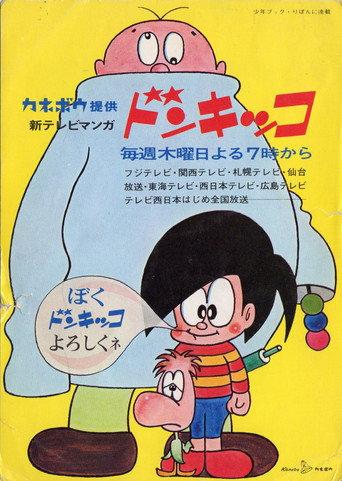
Don Quijote
1967
Insufficient evidence
We did not find enough credible, independent evidence to publish a numeric cash-grab score. Unrated is more honest than a guess.
What counts as a cash grab?
Commercial extraction prioritized over meaningful consumer or creative value. Profit, popularity, adaptations, sequels, remakes, high budgets, and normal marketing do not count by themselves.
Why?
Don Quijote is the English listing for the Japanese anime Donkikko, an adaptation of Shotaro Ishinomori’s manga produced by P Productions and broadcast on Fuji Television from September 7, 1967 to January 25, 1968 with roughly 42 episodes in black and white. Primary production records and trade-style databases document a standard manga-to-anime broadcast production with credited staff and some theme-song releases. I found no credible contemporaneous reporting or later trade reporting that alleges predatory monetization, rushed deceptive release practices, or low-effort reuse consistent with the definition of a cash grab.
- The title corresponds to the 1967 Japanese anime Donkikko, produced by P Productions and aired on Fuji TV, with detailed credits recorded.
- The series is a direct adaptation of a Shotaro Ishinomori manga, indicating original source material and episode production rather than trivial reuse.
- I found no trade reporting, press investigations, or consumer-price disclosures alleging predatory monetization or deceptive release practices.
View full breakdownHide full breakdown
Score factors
| Direction | Factor | Evidence | Impact |
|---|---|---|---|
| Against | Production origin and credits | Don Quijote is the English listing for the Japanese anime Donkikko, adapted from a Shotaro Ishinomori manga, produced by P Productions and broadcast on Fuji Television from September 7, 1967 to January 25, 1968 with credits and episode listings recorded in multiple databases.[1][4][3] | -18 |
| Against | Adaptation from established manga | The television series is based on a serialized manga by Shotaro Ishinomori and the manga has been reissued digitally, showing substantive narrative source material rather than trivial reuse.[1][5][2] | -14 |
| Against | Home-video and merchandising presence | There is modest secondary-market activity and theme-song releases documented, and digital manga reissues, but databases and fandom notes indicate no widespread official DVD/Blu-ray release containing all episodes.[2][6] | -8 |
Confidence: Low · No source-backed commercial-extraction signal was found. · Researched 2026-07-27
Sources reviewed
- [1]en.wikipedia.org
- [2]ishinomori-shotaro.fandom.com
- [3]www.moviefone.com
- [4]www.allcinema.net
- [5]booklive.jp
- [6]www.dvdplanetstore.pk
- [7]en.wikipedia.org
- [8]www.oocities.org
- [9]thetvdb.com
- [10]www.researchgate.net
View 43 more sourcesShow fewer sources
- [11]en.wikipedia.org
- [12]www.niu.edu
- [13]fh.mdp.edu.ar
- [14]www.tvinsider.com
- [15]dubdb.fandom.com
- [16]revistas.uma.es
- [17]es.scribd.com
- [18]list.fandom.com
- [19]es.scribd.com
- [20]dosen.profillengkap.com
- [21]it.wikipedia.org
- [22]www.comptoirlitteraire.com
- [23]www.ehumanista.ucsb.edu
- [24]www.massimoarduini.it
- [25]www.massimoarduini.it
- [26]en.wikipedia.org
- [27]www.animemorial.net
- [28]www.ctk.ne.jp
- [29]animeschedule.net
- [30]blog.livedoor.jp
- [31]www.animemorial.net
- [32]www.allcinema.net
- [33]bgm.tv
- [34]arashi-n.pinoko.jp
- [35]blog.livedoor.jp
- [36]simkl.com
- [37]zh.wikipedia.org
- [38]www.allcinema.net
- [39]dl.ndl.go.jp
- [40]www.allcinema.net
- [41]something-else.net
- [42]eprints.lib.hokudai.ac.jp
- [43]books.rakuten.co.jp
- [44]books.rakuten.co.jp
- [45]movie-tsutaya.tsite.jp
- [46]books.rakuten.co.jp
- [47]mdb.tower.jp
- [48]books.rakuten.co.jp
- [49]www.ghibli-museum.jp
- [50]www.allcinema.net
- [51]www.allcinema.net
- [52]www.allcinema.net
- [53]alcine.org