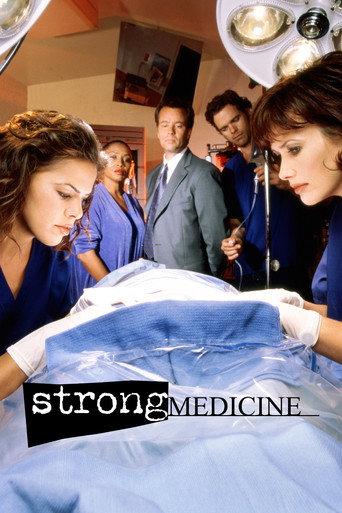
Strong Medicine
2000
The sourced concerns are substantially offset by delivered value.
What counts as a cash grab?
Commercial extraction prioritized over meaningful consumer or creative value. Profit, popularity, adaptations, sequels, remakes, high budgets, and normal marketing do not count by themselves.
Why?
Strong Medicine is a Lifetime medical drama (2000-2006) created by Whoopi Goldberg and Tammy Ader that ran six seasons and 132 episodes. I found no credible reporting that the series was produced or marketed as a predatory cash grab. Contemporary press frames the show as a purpose-driven series about women’s health. The clearest negative consumer signal is limited home‑media availability, with only partial DVD release noted, but there is no evidence of exploitative pricing, rushed deceptive release, or engineered low-effort reuse.
- No credible reporting or trade coverage alleges predatory monetization or deceptive release practices tied to Strong Medicine.
- Press coverage shows Whoopi Goldberg and Tammy Ader conceived the show to address women’s health, indicating substantive intent.
- The series ran six seasons and received mainstream reviews, showing sustained network investment rather than a one-off cash grab.
View full breakdownHide full breakdown
- Home‑media availability is limited, Wikipedia notes only one season on DVD, which is a consumer-unfriendly distribution fact but not proof of extraction.
Score factors
| Direction | Factor | Evidence | Impact |
|---|---|---|---|
| For | No published predatory monetization | I found no trade or news reporting that the series used predatory pricing, microtransactions, or pay-to-view schemes as a revenue-first strategy.[1][2] | +19 |
| Against | Creators framed the show as women’s health drama | Contemporary press reports describe Whoopi Goldberg and Tammy Ader developing Strong Medicine to focus on women’s health and feminist politics, indicating substantive editorial intent.[3][4] | -17 |
| Against | Multi-season run and mainstream reviews | The show ran six seasons with 132 episodes and received routine coverage and reviews from mainstream outlets, indicating sustained production investment rather than a quick exploitative release.[1][5] | -14 |
| For | No reporting of rushed or deceptive release | I found no evidence in trade press or mainstream reporting that the series was rushed out, marketed deceptively, or packaged in bait-and-switch releases.[7][6] | +9 |
Confidence: Medium · Mainstream press, episode and distribution records provide good coverage of production intent and run length, and no trade reporting alleges exploitative monetization, but there is limited public financial detail about Lifetime’s internal revenue strategy so absolute certainty is limited. · Researched 2026-08-05
Sources reviewed
- [1]en.wikipedia.org
- [2]www.imdb.com
- [3]www.latimes.com
- [4]www.washingtonpost.com
- [5]www.commonsensemedia.org
- [6]www.rottentomatoes.com
- [7]www.tvweek.com
- [8]www.truthaboutnursing.org
- [9]www.imdb.com
- [10]www.tvinsider.com
View 35 more sourcesShow fewer sources
- [11]epguides.com
- [12]thetvdb.com
- [13]www.imdb.com
- [14]en.wikipedia.org
- [15]www.primevideo.com
- [16]www.imdb.com
- [17]www.worldradiohistory.com
- [18]www.worldradiohistory.com
- [19]www.scifione.com
- [20]advertise.aarp.org
- [21]www.reddit.com
- [22]citeseerx.ist.psu.edu
- [23]www.api.motion.ac.in
- [24]arxiv.org
- [25]www.imdb.com
- [26]www.cbsnews.com
- [27]tv.apple.com
- [28]www.nexttv.com
- [29]www.tvmaze.com
- [30]www.imdb.com
- [31]www.tvmaze.com
- [32]www.ontariocreates.ca
- [33]en.wikipedia.org
- [34]www.sfgate.com
- [35]ibha.indiana.edu
- [36]scholar.lib.vt.edu
- [37]en.wikipedia.org
- [38]study.sagepub.com
- [39]www.reddit.com
- [40]tooeleonline.com
- [41]d8bc8831c22efb78a586-a3a01b483b2fbabd33a43c2148c64365.ssl.cf2.rackcdn.com
- [42]tooeleonline.com
- [43]www.reddit.com
- [44]www.reddit.com
- [45]www.reddit.com
What does the community think?
The AI sees low cash-grab risk. What's your read?
Loading community verdict…