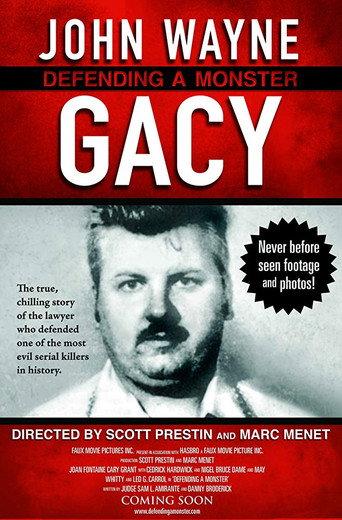
John Wayne Gacy: Defending a Monster
2019
The sourced concerns are substantially offset by delivered value.
What counts as a cash grab?
Commercial extraction prioritized over meaningful consumer or creative value. Profit, popularity, adaptations, sequels, remakes, high budgets, and normal marketing do not count by themselves.
Why?
John Wayne Gacy: Defending a Monster (2019) is an authorized documentary based on the book by Sam Amirante that has festival screenings and standard documentary distribution on VOD and streaming. I found no credible reporting of predatory monetization, deceptive or rushed release practices, or explicit overpriced packaging tied to this title. Production credits and promotional materials describe named directors, producers, and the book source, which point to conventional documentary production rather than clear commercial exploitation.
- No credible sources report predatory monetization, deceptive release, or price gouging for this title.
- Film is described as the authorized documentary adaptation of Sam Amirante’s book.
- Listed directors and producers and festival exhibition indicate typical documentary production.
View full breakdownHide full breakdown
- Widely available on standard VOD/streaming platforms rather than exclusive paywall tie-ins.
Score factors
| Direction | Factor | Evidence | Impact |
|---|---|---|---|
| Against | Authorized adaptation | The film is presented as the official, authorized documentary of the book by Sam Amirante and Danny Broderick.[1][2] | -12 |
| Against | Named creative team | Credits list named directors and producers including Scott Prestin and Marc Menet, indicating attributed creative labor.[4][1] | -10 |
| For | No reported predatory monetization | I found no reporting or official disclosures alleging predatory monetization, add-on merchandising schemes, or deceptive paywall tactics for this documentary.[3][1] | +8 |
| Against | Festival and standard distribution | Records show festival exhibition and availability on VOD/streaming platforms which indicates conventional documentary release practices rather than deceptive rushed release.[2][5] | -7 |
| For | No evidence of low effort reuse | I found no sources documenting substantial reuse of prior footage, stock compilation presented as new work, or other demonstrable low-effort practices.[1][3] | +6 |
Confidence: Medium · Available sources provide standard production and distribution details but lack detailed reporting on financial terms, internal production budgets, or publisher agreements so extraction signals cannot be fully ruled out. · Researched 2026-10-13
Sources reviewed
- [1]www.imdb.com
- [2]letterboxd.com
- [3]www.rottentomatoes.com
- [4]www.rottentomatoes.com
- [5]watch.plex.tv
- [6]www.rottentomatoes.com
- [7]pro.imdb.com
- [8]www.imdb.com
- [9]www.tvguide.com
- [10]watch.plex.tv
View 14 more sourcesShow fewer sources
- [11]www.justwatch.com
- [12]www.imdb.com
- [13]en.wikipedia.org
- [14]www.reddit.com
- [15]en.wikipedia.org
- [16]a.comtex-nj.com
- [17]mvd.cloud
- [18]en.wikipedia.org
- [19]en.wikipedia.org
- [20]en.wikipedia.org
- [21]mvd.cloud
- [22]en.wikipedia.org
- [23]alpha.creativecirclecdn.com
- [24]9c519110712a1cc5ffdf-b1b745d17d9877b298ac94fd86f5428e.ssl.cf2.rackcdn.com
What does the community think?
The AI sees low cash-grab risk. What's your read?
Loading community verdict…