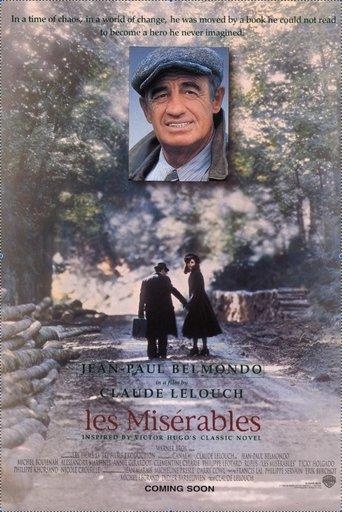
Les Miserables
1995
The sourced concerns are substantially offset by delivered value.
What counts as a cash grab?
Commercial extraction prioritized over meaningful consumer or creative value. Profit, popularity, adaptations, sequels, remakes, high budgets, and normal marketing do not count by themselves.
Why?
Les Misérables (1995), directed and produced by Claude Lelouch and starring Jean-Paul Belmondo, is a nearly three hour transposition of Victor Hugo’s novel into early 20th century France with large-scale production values and festival recognition. Contemporary reviews and distributor materials describe it as an inventive reinterpretation that intercuts filmed passages of Hugo with a World War II narrative rather than a straight remake. I found no reporting that the title was released with predatory monetization, deceptive timing, or obvious low-effort reuse aimed primarily at extracting consumer dollars.
- No credible sources report predatory monetization, rushed release, or deceptive pricing for the 1995 film.
- Directed, produced, and written by Claude Lelouch with major French stars, indicating substantial production investment.
- Contemporary critics characterized the film as an inventive reinterpretation, not a perfunctory retread of the property.
View full breakdownHide full breakdown
- Distributor and catalogue entries and festival awards document standard theatrical release and later archival restoration.
Score factors
| Direction | Factor | Evidence | Impact |
|---|---|---|---|
| Against | Production craft and scale | The film was written, produced and directed by Claude Lelouch, features Jean-Paul Belmondo and other notable actors, runs nearly three hours, and lists multiple credited composers and cinematographers, indicating substantial production investment.[1] | -18 |
| Against | Substantive reinterpretation of source | Critics and catalogues describe the film as a free adaptation that transposes Hugo’s themes into a 20th century World War II storyline centered on an original protagonist, Henri Fortin, rather than merely reusing the musical or prior screen versions.[2][3] | -16 |
| Against | Standard theatrical distribution and recognition | Distributor and catalogue entries show theatrical distribution, festival screenings and awards such as an Audience Choice prize and a Golden Globe for Best Foreign Language Film, consistent with a complete consumer-facing release.[1][3] | -8 |
| Against | Artistic scope and risk | Contemporary reviews note the film’s sprawling three hour structure, intercut timelines and filmed excerpts from Hugo, descriptions that point to artistic risk rather than mechanical franchise reuse.[4][2] | -6 |
| For | No evidence of exploitative monetization | I found no credible production reporting, press, distributor notices, or contemporary reviews that allege predatory monetization practices, aggressive add-on commerce, rushed or deceptive release timing, or a price/value mismatch for this title.[4][1][2] | +5 |
Confidence: High · Multiple contemporary reviews and distributor catalogue material provide direct reporting on the film’s production, release, and reception, though detailed archival financial disclosures are limited in public sources. · Researched 2026-08-29
Sources reviewed
- [1]www.rialtopictures.com
- [2]www.reelviews.net
- [3]www.lesfilms13.com
- [4]www.washingtonpost.com
- [5]en.wikipedia.org
- [6]www.rogerebert.com
- [7]fr.wikipedia.org
- [8]www.rottentomatoes.com
- [9]fr.wikipedia.org
- [10]victorhugoressources.paris.fr
View 10 more sourcesShow fewer sources
What does the community think?
The AI sees low cash-grab risk. What's your read?
Loading community verdict…