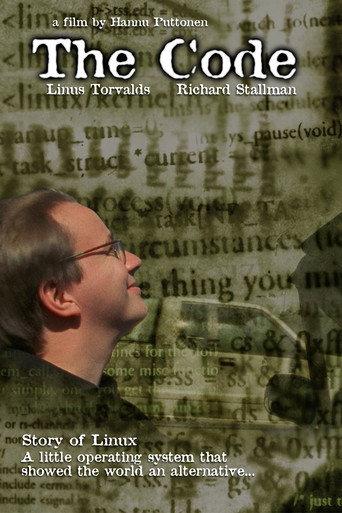
The Code
2001
The sourced concerns are substantially offset by delivered value.
What counts as a cash grab?
Commercial extraction prioritized over meaningful consumer or creative value. Profit, popularity, adaptations, sequels, remakes, high budgets, and normal marketing do not count by themselves.
Why?
The Code (2001) is a Finnish-made, English-language documentary directed by Hannu Puttonen that chronicles the early history of GNU/Linux and features on-camera interviews with Linus Torvalds, Richard M. Stallman, Eric S. Raymond and other core free software figures. Festival listings, TV-broadcast archives and film database entries describe a finished 52-58 minute documentary intended for public screening. In the sources consulted there is substantive primary-source content and no documented evidence of predatory monetization, deceptive release practices, or deliberate brand exploitation.
- Contains on-camera interviews with Linus Torvalds, Richard Stallman, Eric S. Raymond and other primary figures.
- Documented festival screenings and TV distribution indicate a standard documentary production and release.
- Multiple film archives and databases describe original reporting and historical narrative rather than cheap reuse.
View full breakdownHide full breakdown
- Searches of distribution and sales materials produced no evidence of predatory monetization or deceptive pricing.
Score factors
| Direction | Factor | Evidence | Impact |
|---|---|---|---|
| Against | Primary-source interviews | The film includes interviews with Linus Torvalds, Richard M. Stallman, Eric S. Raymond and several other central figures in the free software movement.[2][4][1] | -18 |
| Against | Finished production and festival/broadcast distribution | The Code is described as a 52-58 minute documentary directed by Hannu Puttonen with festival screenings and TV broadcast listings, indicating completed production and conventional distribution.[5][3][1] | -12 |
| Against | Accessible language and runtime | Sources list the film as English language with a roughly one-hour runtime and festival/TV availability, consistent with a consumer-oriented documentary rather than a bait product.[2][3][6] | -8 |
| For | No evidence of predatory monetization found | Contemporary and archival sources consulted do not document premium pricing, bundled deceptive sales, pay-to-view schemes, or other predatory monetization tied to this documentary.[8][2][7] | +4 |
| For | No sign of shallow brand exploitation | Available reviews, database entries and catalogue notes describe historical narrative and original interviews rather than reuse of brand recognition without substantive content.[1][9][10] | +2 |
Confidence: High · Authoritative film databases, national archives and distribution catalogues provide direct credits, festival and broadcast records showing substantive original content and there is no contemporaneous reporting found of predatory monetization, though detailed private distributor sales contracts were · Researched 2026-09-04
Sources reviewed
- [1]finna.fi
- [2]en.wikipedia.org
- [3]vintti.yle.fi
- [4]www.imdb.com
- [5]www.imdb.com
- [6]www.tvguide.com
- [7]www.imdb.com
- [8]download.sales.arte.tv
- [9]letterboxd.com
- [10]www.sinefil.com
View 31 more sourcesShow fewer sources
- [11]vintti.yle.fi
- [12]www.finna.fi
- [13]guidedoc.tv
- [14]www.theguardian.com
- [15]www.finna.fi
- [16]leonardo.info
- [17]www.linuxquestions.org
- [18]anarchivism.org
- [19]en.wikipedia.org
- [20]de.wikipedia.org
- [21]zh.wikipedia.org
- [22]de.wikipedia.org
- [23]en.wikipedia.org
- [24]cybersecurityventures.com
- [25]www.reddit.com
- [26]citeseerx.ist.psu.edu
- [27]lib.zu.edu.pk
- [28]citeseerx.ist.psu.edu
- [29]pro.imdb.com
- [30]letterboxd.com
- [31]www.senscritique.com
- [32]cineyseries.net
- [33]finna.fi
- [34]www.imdb.com
- [35]en.wikipedia.org
- [36]www.grimstveit.no
- [37]journal.fi
- [38]epe.lac-bac.gc.ca
- [39]files.core.ac.uk
- [40]trepo.tuni.fi
- [41]arxiv.org
What does the community think?
The AI sees low cash-grab risk. What's your read?
Loading community verdict…