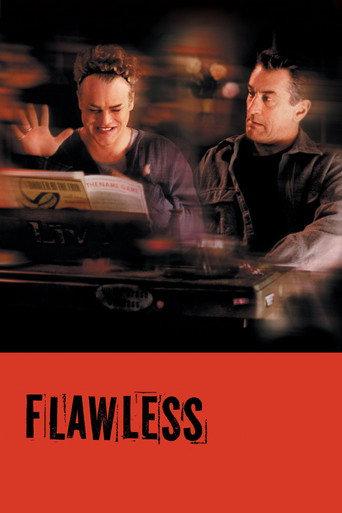
Flawless
1999
The sourced concerns are substantially offset by delivered value.
What counts as a cash grab?
Commercial extraction prioritized over meaningful consumer or creative value. Profit, popularity, adaptations, sequels, remakes, high budgets, and normal marketing do not count by themselves.
Why?
Flawless (1999), written and directed by Joel Schumacher and starring Robert De Niro and Philip Seymour Hoffman, received mixed reviews but shows no documented predatory monetization or deceptive release practices; its reported production budget is roughly $15-27 million while theatrical returns were very low, indicating commercial failure rather than an extraction strategy. Contemporary reviews emphasize performances and melodramatic craft rather than obvious low-effort reuse or franchise exploitation. No sources found that allege deliberate cash-grab tactics such as deceptive pricing or rushed monetization.
- Box office returns were far below reported production budget, indicating commercial failure not profitable exploitation.
- Major trade and critical coverage focus on performances and screenplay, not on predatory monetization or low-effort reuse.
- No evidence located of deceptive release practices, tie-in monetization, or price/value manipulations.
View full breakdownHide full breakdown
- Film is an original, standalone drama by a known director, not a sequel, remake, or franchise vehicle.
Score factors
| Direction | Factor | Evidence | Impact |
|---|---|---|---|
| For | Box office vs budget | Reported production budgets of $15-27 million contrast with US box office under $500,000, showing the film failed commercially rather than extracting profit through theatrical exploitation.[3][1] | +16 |
| Against | Critical focus on performances | Reviews highlight strong central performances by De Niro and Hoffman and discuss screenplay and direction, indicating substantive creative effort rather than a low-effort cash grab.[4][2] | -14 |
| Against | Not franchise or remake | Flawless is an original screenplay by Joel Schumacher and is not part of a franchise, sequel, or adaptation that would alone imply brand-exploitation.[1] | -10 |
| Against | No predatory monetization found | Contemporary reviews and production coverage do not report pay-for-access schemes, deceptive packaging, or aggressive tie-in monetization for this title.[2][5] | -9 |
Confidence: High · Contemporary reviews, box office records, and production credits provide clear evidence; there are no trade reports or disclosures alleging predatory monetization or deceptive practices, though home video revenue details are not exhaustively available in the cited sources. · Researched 2026-10-07
Sources reviewed
- [1]en.wikipedia.org
- [2]www.rogerebert.com
- [3]www.the-numbers.com
- [4]www.rottentomatoes.com
- [5]www.latimes.com
- [6]www.imdb.com
- [7]pmc.ncbi.nlm.nih.gov
- [8]www.themoviedb.org
- [9]tv.apple.com
- [10]www.rottentomatoes.com
View 12 more sourcesShow fewer sources
What does the community think?
The AI sees low cash-grab risk. What's your read?
Loading community verdict…