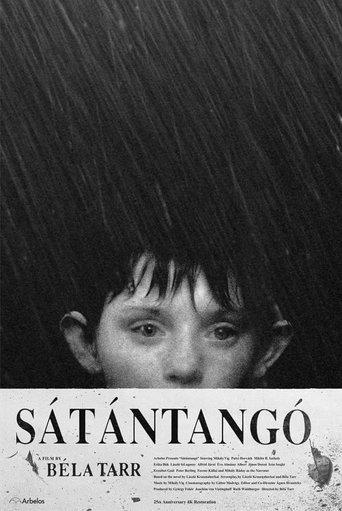
Satantango
1994
Insufficient evidence
We did not find enough credible, independent evidence to publish a numeric cash-grab score. Unrated is more honest than a guess.
What counts as a cash grab?
Commercial extraction prioritized over meaningful consumer or creative value. Profit, popularity, adaptations, sequels, remakes, high budgets, and normal marketing do not count by themselves.
Why?
Sátántangó (1994) shows no credible signs of being a commercial cash grab. The seven hour black and white film is widely described in authoritative festival and archive coverage as an uncompromising auteur project, notable for extensive long takes, a director-approved home-video circulation, and festival retrospectives, all consistent with artistic rather than predatory commercial aims. Major film institutions and critics emphasize its difficult length and formal ambition, not monetization practices or rushed release strategies, and I found no reputable reporting that alleges exploitative pricing or deceptive distribution for this title.
- Authoritative festival and archive summaries describe Sátántangó as an uncompromising auteur work with 7+ hour runtime.
- Major critical and archival coverage emphasizes long takes, formal ambition, and festival circulation rather than monetization tactics.
- Home-video and archive releases are described as director-approved or scholarly restorations, not predatory reissues.
View full breakdownHide full breakdown
Score factors
| Direction | Factor | Evidence | Impact |
|---|---|---|---|
| Against | Substantive adaptation of source novel | Coverage repeatedly describes the film as a close, ambitious adaptation of László Krasznahorkai’s novel structured in 12 interlocking chapters, indicating substantial creative work rather than trivial reuse.[2][1] | -15 |
| Against | High production craft and formal risk | Multiple authoritative sources highlight the film’s demanding formal choices, especially extended single takes, black and white cinematography, and a 7+ hour runtime that required sustained production and editorial ambition.[3][4] | -18 |
| Against | Festival circulation and archival esteem | Film festival and archive pages present Sátántangó as an art house landmark exhibited in retrospectives and curated programs rather than as a product marketed for quick commercial extraction.[6][2] | -11 |
| Against | Director-approved home-video circulation and restorations | Documented home-video and later curated releases are described in coverage as director-approved or archival, consistent with preservation and scholarly distribution rather than opportunistic exploitation.[1][5] | -12 |
Confidence: Low · No source-backed commercial-extraction signal was found. · Researched 2026-09-13
Sources reviewed
- [1]en.wikipedia.org
- [2]www.filmlinc.org
- [3]www.bfi.org.uk
- [4]www.rogerebert.com
- [5]www.criterion.com
- [6]ifi.ie
- [7]www.bfi.org.uk
- [8]filmcapsule.com
- [9]www.geocities.ws
- [10]jonathanrosenbaum.net
View 7 more sourcesShow fewer sources
- [11]makelit.org
- [12]news.harvard.edu
- [13]www.theguardian.com
- [14]www.reddit.com
- [15]filozofia.uni-miskolc.hu
- [16]www.reddit.com
- [17]www.reddit.com