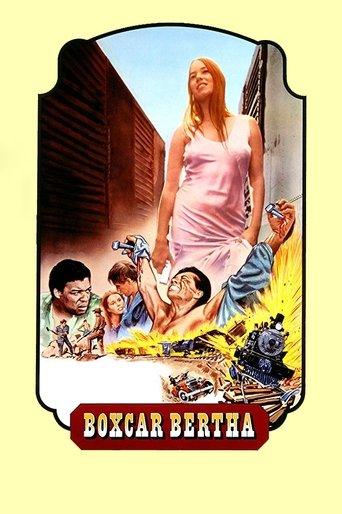
Boxcar Bertha
1972
The sourced concerns are substantially offset by delivered value.
What counts as a cash grab?
Commercial extraction prioritized over meaningful consumer or creative value. Profit, popularity, adaptations, sequels, remakes, high budgets, and normal marketing do not count by themselves.
Why?
Boxcar Bertha (1972) was produced by Roger Corman and widely presented as a low-budget exploitation picture, shot quickly and marketed for sex and violence to the summer drive-in trade, which provides evidence of commercial extraction intent. Contemporary reviewers and production histories record that Corman commissioned the picture as a Corman quickie, yet critics and participants also note Martin Scorsese's direction and Barbara Hershey's performance gave the film unexpected depth, which mitigates a pure cash-grab characterization.
- Produced and marketed by Roger Corman as a low-budget exploitation 'quickie'.
- Contemporary coverage and archives record rapid, austere production practices under Corman.
- Critics and participants report Scorsese's direction elevated the material beyond mere exploitation.
View full breakdownHide full breakdown
- No sources found documenting predatory post-release monetization or deceptive pricing tied to this title.
Score factors
| Direction | Factor | Evidence | Impact |
|---|---|---|---|
| For | Producer exploitation intent | Roger Corman produced Boxcar Bertha and contemporary reviews and histories describe it as a deliberately marketed exploitation picture aimed at drive-in and summer trade.[1][3][2] | +20 |
| For | Rapid, low-budget production | Multiple sources describe Boxcar Bertha as a Roger Corman 'quickie' shot on an austere budget and produced rapidly in the South, signaling a production model focused on cost efficiency.[1][2][6] | +18 |
| For | Marketing emphasized sex and violence | Contemporary publicity and retrospective summaries note the film was publicized by Corman as an exploitation picture promising sex and violence, which aligns with an extraction-driven marketing strategy.[1][5][4] | +15 |
| Against | Scorsese's direction elevated the film | Critics and participants report that Martin Scorsese's direction and stylistic choices gave Boxcar Bertha more depth and craft than its exploitation marketing suggested.[3][1][4] | -15 |
| Against | Thematic and performance substance | Contemporary reviews and participant recollections note the film contains Depression-era labor themes and performances, for example Barbara Hershey's, which count against a finding of merely predatory reuse.[1][5][7] | -10 |
Confidence: High · Multiple reputable contemporary reviews and film-reference sources explicitly describe Corman's exploitation production model and Scorsese's artistic contribution, though detailed studio accounting or post-release monetization records are not available in the consulted sources. · Researched 2026-07-31
Sources reviewed
- [1]en.wikipedia.org
- [2]www.tcm.com
- [3]www.rogerebert.com
- [4]www.rottentomatoes.com
- [5]en.wikipedia.org
- [6]www.imdb.com
- [7]catalog.afi.com
- [8]www.imdb.com
- [9]www.rottentomatoes.com
- [10]www.imdb.com
View 15 more sourcesShow fewer sources
- [11]www.imdb.com
- [12]www.bfi.org.uk
- [13]catalog.afi.com
- [14]www.tvguide.com
- [15]www.worldradiohistory.com
- [16]es.wikipedia.org
- [17]de.wikipedia.org
- [18]fr.wikipedia.org
- [19]www.cinemah.com
- [20]en.wikipedia.org
- [21]cinema.indiana.edu
- [22]elcv.art.br
- [23]www.acsu.buffalo.edu
- [24]www.collectionscanada.gc.ca
- [25]www.youtube.com
What does the community think?
The AI sees low cash-grab risk. What's your read?
Loading community verdict…