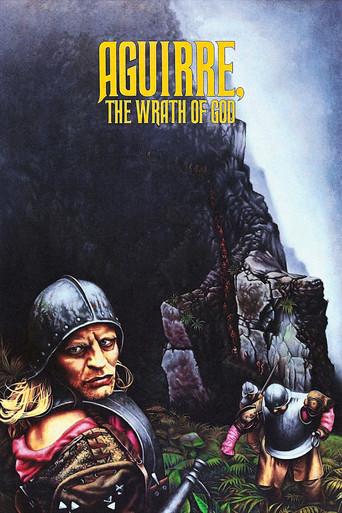
Aguirre, the Wrath of God
1972
Insufficient evidence
We did not find enough credible, independent evidence to publish a numeric cash-grab score. Unrated is more honest than a guess.
What counts as a cash grab?
Commercial extraction prioritized over meaningful consumer or creative value. Profit, popularity, adaptations, sequels, remakes, high budgets, and normal marketing do not count by themselves.
Why?
Aguirre, the Wrath of God is Werner Herzog’s 1972 location-shot epic starring Klaus Kinski, made on a modest reported budget of about $370,000 and filmed in the Peruvian Amazon with a five week shoot after extensive preproduction. Contemporary and retrospective reporting emphasizes difficult, deliberate production choices, strong artistic intent, and continued archival releases and restorations, and I found no credible evidence of predatory monetization, rushed or deceptive release practices, or low-effort reuse consistent with a cash grab.
- On-location, chronologically shot production and extensive preproduction indicate substantial craft and risk.
- Reported budget (~$370,000) and accounts that a large share went to Kinski reflect investment in cast, not assembly-line reuse.
- Widespread critical and archival attention, restorations and scholarly treatment indicate enduring artistic value.
View full breakdownHide full breakdown
Score factors
| Direction | Factor | Evidence | Impact |
|---|---|---|---|
| Against | On-location production and craft | The film was shot entirely on location in Peru, filmed in chronological order with a five week shoot following nine months of pre-production, demonstrating substantial production effort and risk.[1][3][4] | -18 |
| Against | Artistic and technical risk | Reporting and criticism frame Aguirre as a high artistic risk work, shot in dangerous river and jungle conditions and praised as a masterpiece rather than produced to exploit a franchise.[8][2][4] | -9 |
| Against | Original screenplay and creative authorship | The film is written and directed by Werner Herzog and is presented as an original dramatic reworking of historical material, not as a low-effort reuse or repackaging of prior filmed assets.[1][2] | -16 |
| Against | Budget allocation and casting | Sources report a modest production budget of about $370,000 and repeated claims that a large fraction was paid to Klaus Kinski, which indicates allocation toward talent rather than low-effort extraction practices.[1][6][5] | -12 |
| Against | Archival restorations and critical scholarship | Recent restorations, BFI and archival releases and a dedicated BFI Film Classics study indicate ongoing curator and scholarly investment, which mitigates the claim that the title exists primarily as an exploitative cash grab.[2][3][7] | -11 |
Confidence: Low · No source-backed commercial-extraction signal was found. · Researched 2026-07-23
Sources reviewed
- [1]en.wikipedia.org
- [2]www.bfi.org.uk
- [3]www.bfi.org.uk
- [4]www.theguardian.com
- [5]www.perlego.com
- [6]www.deepfocusreview.com
- [7]www.criterion.com
- [8]www.rogerebert.com
- [9]www.boxofficemojo.com
- [10]www.rogerebert.com
View 72 more sourcesShow fewer sources
- [11]www.rottentomatoes.com
- [12]www.imdb.com
- [13]oak3.the-numbers.com
- [14]www.rogerebert.com
- [15]m.imdb.com
- [16]es.wikipedia.org
- [17]de.wikipedia.org
- [18]www.rogerebert.com
- [19]www.timeout.com
- [20]www.criterion.com
- [21]en.wikipedia.org
- [22]www.reddit.com
- [23]www.reddit.com
- [24]urresearch.rochester.edu
- [25]www.reddit.com
- [26]www.reddit.com
- [27]german.washington.edu
- [28]pt.wikipedia.org
- [29]www.classicartfilms.com
- [30]www.on-magazine.co.uk
- [31]everything.explained.today
- [32]dosen.profillengkap.com
- [33]fourstarfilmfan.com
- [34]www.audible.com
- [35]www.researchgate.net
- [36]www.classicartfilms.com
- [37]dokumen.pub
- [38]www.newsweek.com
- [39]rohandrape.net
- [40]www.reddit.com
- [41]en.wikipedia.org
- [42]www.imdb.com
- [43]forum.blu-ray.com
- [44]www.imdb.com
- [45]www.imdb.com
- [46]forum.blu-ray.com
- [47]forums.whirlpool.net.au
- [48]www.talkinbroadway.com
- [49]forum.blu-ray.com
- [50]www.blu-ray.com
- [51]forum.blu-ray.com
- [52]pure.plymouth.ac.uk
- [53]shop.bfi.org.uk
- [54]www.bfi.org.uk
- [55]shop.bfi.org.uk
- [56]www2.bfi.org.uk
- [57]shop.bfi.org.uk
- [58]www.bloomsbury.com
- [59]tv.apple.com
- [60]tv.apple.com
- [61]tv.apple.com
- [62]www.justwatch.com
- [63]api.pageplace.de
- [64]api.pageplace.de
- [65]www.broadway.org.uk
- [66]fr.wikipedia.org
- [67]uwe-repository.worktribe.com
- [68]e-space.mmu.ac.uk
- [69]zh.wikipedia.org
- [70]www.imdb.com
- [71]culture.fandom.com
- [72]www.imdb.com
- [73]m.imdb.com
- [74]filminperu.peru.info
- [75]pages.cs.wisc.edu
- [76]helposter.com
- [77]en-academic.com
- [78]bennythomas.wordpress.com
- [79]www.reddit.com
- [80]dokumen.pub
- [81]pdfcoffee.com
- [82]pdfcoffee.com