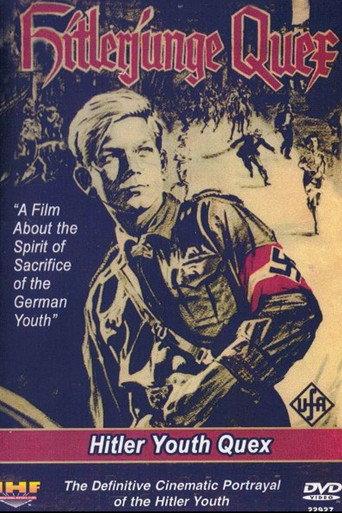
Hitler Youth Quex
1933
The sourced concerns are substantially offset by delivered value.
What counts as a cash grab?
Commercial extraction prioritized over meaningful consumer or creative value. Profit, popularity, adaptations, sequels, remakes, high budgets, and normal marketing do not count by themselves.
Why?
Hitler Youth Quex (Hitlerjunge Quex, 1933) was produced under direct Nazi Party influence as a piece of youth recruitment propaganda, with Ufa and party leaders involved in production and a gala premiere featuring an orchestral performance and a Baldur von Schirach speech. Contemporary and historical sources describe it as both a propaganda staple and a commercial success for Ufa. I found clear evidence of political exploitation and of significant production effort, but no sourced evidence of predatory pricing, deceptive release tactics, or other commercial cash-grab mechanics.
- Nazi leadership oversight and explicit recruitment intent are documented in film histories and archival descriptions.
- Contemporary records and museum descriptions report a gala premiere and that Ufa treated the picture as a financial success.
- The film was based on a bestselling 1932 novel and received a large, staged production with music and ceremony.
View full breakdownHide full breakdown
- No credible sources found that document predatory monetization, deceptive release schedules, or price/value mismatch for this title.
Score factors
| Direction | Factor | Evidence | Impact |
|---|---|---|---|
| For | Party oversight and use for recruitment | Contemporary documentation and film histories state that the film was produced with Nazi leadership involvement and used as a Hitler Youth recruitment and propaganda vehicle.[1][2] | +20 |
| For | Documented financial success and wide screening | Museum and film-historical sources describe the picture as a financial hit for Ufa and one of the season's most successful releases.[3][1] | +18 |
| Against | Gala premiere and staged production | Reports record a gala premiere with a Bruckner performance and a speech by Baldur von Schirach, indicating substantial staging and production investment.[4][2] | -15 |
| Against | Adaptation of a popular contemporary novel | The film adapts Karl Aloys Schenzinger's 1932 novel about Herbert Norkus, which sold widely and provided substantive source material for the movie.[5][6] | -11 |
| For | Explicit propaganda content and postwar prohibition | Scholarly and archival sources characterize the film as explicit National Socialist propaganda promoting the Hitler Youth and note it was banned by Allied authorities after the war.[1][2] | +10 |
Confidence: High · Multiple reputable film-historical and museum sources directly document Nazi oversight, the gala premiere, and the film's financial and propaganda role, while no sources were found alleging predatory monetization or deceptive commercial practices. · Researched 2026-08-12
Sources reviewed
- [1]www.filmportal.de
- [2]germanhistorydocs.org
- [3]www.dhm.de
- [4]search.worldcat.org
- [5]en.wikipedia.org
- [6]psi312.cankaya.edu.tr
- [7]germanhistorydocs.org
- [8]en.wikipedia.org
- [9]www.imdb.com
- [10]de.wikipedia.org
View 12 more sourcesShow fewer sources
- [11]www.filmportal.de
- [12]www.imdb.com
- [13]fileserver-az.core.ac.uk
- [14]www.cinema.de
- [15]www.imdb.com
- [16]mk.christogenea.org
- [17]en.wikipedia.org
- [18]www.jewiki.net
- [19]core.ac.uk
- [20]prussia.online
- [21]en.wikipedia.org
- [22]en.wikipedia.org
What does the community think?
The AI sees low cash-grab risk. What's your read?
Loading community verdict…