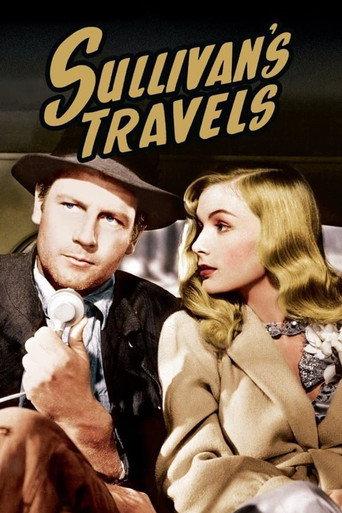
Sullivan's Travels
1941
The sourced concerns are substantially offset by delivered value.
What counts as a cash grab?
Commercial extraction prioritized over meaningful consumer or creative value. Profit, popularity, adaptations, sequels, remakes, high budgets, and normal marketing do not count by themselves.
Why?
Sullivan's Travels (1941), written and directed by Preston Sturges, is widely documented as a critically acclaimed satire of Hollywood made during Sturges's prolific early 1940s run. Contemporary and retrospective sources highlight careful production, social commentary, and lasting artistic recognition including selection for the U.S. National Film Registry. I found no credible contemporaneous or modern evidence that the film was produced or marketed as a predatory commercial extraction rather than a crafted artistic work.
- Contemporary production reporting and retrospective essays emphasize deliberate writing, direction, and deliberate production choices.
- Major film institutions and critics treat the film as artistically significant and socially engaged rather than exploitative.
- Library of Congress and Criterion coverage note substantive thematic content and craftsmanship.
View full breakdownHide full breakdown
- I found no sourced claims of predatory monetization, rushed deceptive release practices, or low-effort reuse.
Score factors
| Direction | Factor | Evidence | Impact |
|---|---|---|---|
| Against | Production craft and authorship | Preston Sturges wrote and directed Sullivan's Travels during a noted creative run, with production dates and budget details recorded and discussed in production histories.[3][1] | -18 |
| For | No sourced evidence of exploitative monetization | Searched production histories, institutional essays, and contemporary reporting and found no credible claims of predatory monetization, deceptive release, or price/value mismatch tied to this title.[4][2] | +18 |
| Against | Substantive thematic and social content | Scholarly and institutional essays describe the film as a satire with meaningful social commentary, notably the church sequence praised by contemporaries and civil rights figures.[2][1] | -17 |
| Against | Critical acclaim and preservation | The film has sustained high critical regard, holds a perfect rating on many aggregators, and was added to the U.S. National Film Registry for cultural, historical, or aesthetic significance.[6][3][5] | -12 |
Confidence: High · Multiple authoritative contemporary and retrospective sources directly discuss production, themes, and lasting recognition, and no credible sources indicate extraction or predatory practices; gaps are minimal for a 1941 release. · Researched 2026-10-31
Sources reviewed
- [1]www.tcm.com
- [2]www.loc.gov
- [3]www.criterion.com
- [4]www.criterion.com
- [5]www.rottentomatoes.com
- [6]en.wikipedia.org
- [7]catalog.afi.com
- [8]www.tcm.com
- [9]catalog.afi.com
- [10]www.criterion.com
View 17 more sourcesShow fewer sources
- [11]www.bfi.org.uk
- [12]www.criterion.com
- [13]www.universalpicturesathome.com
- [14]www.tcm.com
- [15]www.walterfilm.com
- [16]www.chicagofilmsociety.org
- [17]www.hardyhar.co.uk
- [18]cdn2.assets-servd.host
- [19]en.wikipedia.org
- [20]de.wikipedia.org
- [21]es.wikipedia.org
- [22]ru.wikipedia.org
- [23]en.wikipedia.org
- [24]www.reddit.com
- [25]www.reddit.com
- [26]www.reddit.com
- [27]www.reddit.com
What does the community think?
The AI sees low cash-grab risk. What's your read?
Loading community verdict…