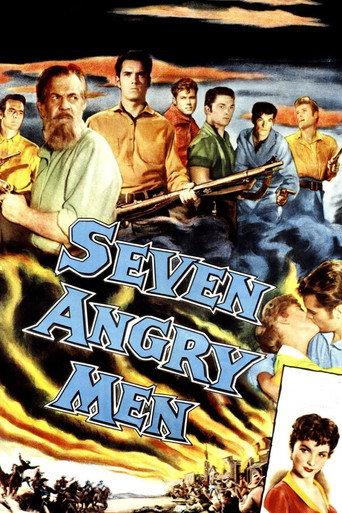
Seven Angry Men
1955
The sourced concerns are substantially offset by delivered value.
What counts as a cash grab?
Commercial extraction prioritized over meaningful consumer or creative value. Profit, popularity, adaptations, sequels, remakes, high budgets, and normal marketing do not count by themselves.
Why?
Seven Angry Men is a 1955 Allied Artists historical Western about John Brown starring Raymond Massey, Jeffrey Hunter and Debra Paget, produced and released as a midcentury studio feature with contemporary reviews describing it as earnest and small scale. I found no credible reporting that the film was rushed, priced predatory, or designed primarily to exploit brand recognition, while trade and archival sources document production history, working titles, and later legitimate home-video availability, which weigh against labeling it a commercial extraction over creative value.
- No trade or archival sources report predatory monetization or deceptive release practices.
- Contemporary and modern reviews describe substantive dramatic treatment and earnest production.
- AFI and TCM production records document conventional studio development rather than rushed cash-driven tactics.
View full breakdownHide full breakdown
- Later Warner Archive home-video release indicates consumer-accessible distribution, not exploitative pricing evidence.
Score factors
| Direction | Factor | Evidence | Impact |
|---|---|---|---|
| For | No reported exploitative monetization | I found no trade reporting or archival documentation alleging predatory pricing, deceptive packaging, or monetization schemes tied to the 1955 release.[1][2] | +18 |
| Against | Documented production and critical treatment | TCM and multiple modern reviews characterize the film as earnest, small scale and dramatizing Brown's actions, indicating substantive creative effort and historical framing.[3][4] | -16 |
| Against | Home-video availability suggests consumer-friendly distribut | A Warner Archive DVD release and subsequent reviews note legitimate home-video availability, which shows standard consumer distribution rather than exploitative repackaging.[6][5] | -8 |
Confidence: Medium · Sources from AFI, TCM, contemporary and modern reviews reliably document production and reception, however there is limited archival trade reporting on box office or studio pricing strategies from 1955 so extraction signals cannot be fully ruled out. · Researched 2026-10-03
Sources reviewed
- [1]en.wikipedia.org
- [2]catalog.afi.com
- [3]www.tcm.com
- [4]www.derekwinnert.com
- [5]www.rottentomatoes.com
- [6]laurasmiscmusings.blogspot.com
- [7]en.wikipedia.org
- [8]pro.imdb.com
- [9]www.imdb.com
- [10]fictionmachine.com
View 16 more sourcesShow fewer sources
- [11]en.wikipedia.org
- [12]runningwildfilms.com
- [13]www.tvguide.com
- [14]www.moviefone.com
- [15]letterboxd.com
- [16]www.themilitant.com
- [17]en.wikipedia.org
- [18]fr.wikipedia.org
- [19]en.wikipedia.org
- [20]journals.ku.edu
- [21]rmtrain.h-net.org
- [22]www.reddit.com
- [23]www.loc.gov
- [24]wp.jeffreyhunter.net
- [25]www.reddit.com
- [26]www.reddit.com
What does the community think?
The AI sees low cash-grab risk. What's your read?
Loading community verdict…