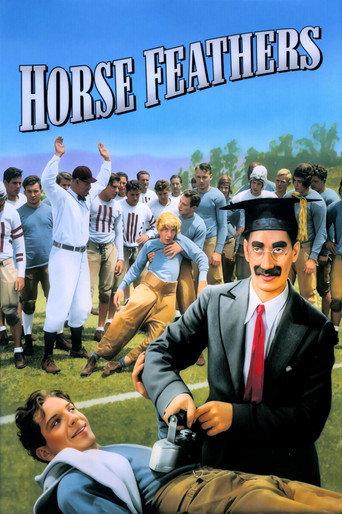
Horse Feathers
1932
The sourced concerns are substantially offset by delivered value.
What counts as a cash grab?
Commercial extraction prioritized over meaningful consumer or creative value. Profit, popularity, adaptations, sequels, remakes, high budgets, and normal marketing do not count by themselves.
Why?
Horse Feathers (1932) is a Marx Brothers comedy produced and distributed by Paramount, filmed with credited writers and a notable director, and it was a commercial hit on release while receiving strong contemporary and modern critical praise. Available evidence shows substantial original performers work, documented production interruptions and on-set incidents, and positive box office and reviews. I found no contemporaneous or archival evidence of predatory monetization, deceptive release tactics, or price/value mismatch that would indicate this film was produced primarily as a cash grab.
- Contemporary box office success and mainstream distribution indicate a standard commercial release rather than predatory monetization.
- Contemporary and later critical praise and sustained scholarly attention point to substantive creative value and craft.
- Documented production events and credited creative personnel show original production effort and investment.
View full breakdownHide full breakdown
- No sources found alleging exploitative pricing, deceptive release, or low-effort reuse of existing footage or assets.
Score factors
| Direction | Factor | Evidence | Impact |
|---|---|---|---|
| Against | Critical reception | Contemporary reviews and later retrospective coverage praised the film's madcap comedy and it secured enduring critical attention, including Time and TCM discussions.[4][2] | -16 |
| Against | Documented production work | AFI catalog and other records document credited writers, director Norman Z. McLeod, production interruptions including Chico Marx's injury, and on-set activity, evidencing actual production effort rather than low-effort reuse.[3][1] | -15 |
| For | Lack of exploitative monetization evidence | I found no archival or trade reporting alleging predatory pricing, deceptive release practices, or franchise-style monetization schemes connected to Horse Feathers.[1][2] | +15 |
| Against | Box office and distribution | Horse Feathers opened August 19, 1932, was distributed by Paramount, and recorded U.S./Canada rentals higher than its budget indicating it was a commercial success on standard theatrical terms.[1][5] | -12 |
| Against | Enduring reputation and availability | The film is frequently cited in film histories, available on modern streaming and archival platforms, and included in AFI and revival programming, supporting ongoing consumer value.[3][6] | -9 |
Confidence: High · Primary filmographic records, contemporary reviews, box office data, and archival catalogs provide strong direct evidence about production, reception, and absence of exploitative monetization; gaps are minimal for a 1932 mainstream theatrical release. · Researched 2026-10-31
Sources reviewed
- [1]en.wikipedia.org
- [2]www.tcm.com
- [3]catalog.afi.com
- [4]content.time.com
- [5]www.boxofficemojo.com
- [6]tv.apple.com
- [7]catalog.afi.com
- [8]www.rottentomatoes.com
- [9]catalog.afi.com
- [10]catalog.afi.com
View 15 more sourcesShow fewer sources
- [11]oregonnews.uoregon.edu
- [12]afisilver.afi.com
- [13]www.walterfilm.com
- [14]www.tcm.com
- [15]moviesanywhere.com
- [16]www.marx-brothers.org
- [17]content.propstore.com
- [18]en.wikipedia.org
- [19]en.wikipedia.org
- [20]s3.amazonaws.com
- [21]content.propstore.com
- [22]en.wikipedia.org
- [23]en.wikipedia.org
- [24]en.wikipedia.org
- [25]time.com
What does the community think?
The AI sees low cash-grab risk. What's your read?
Loading community verdict…