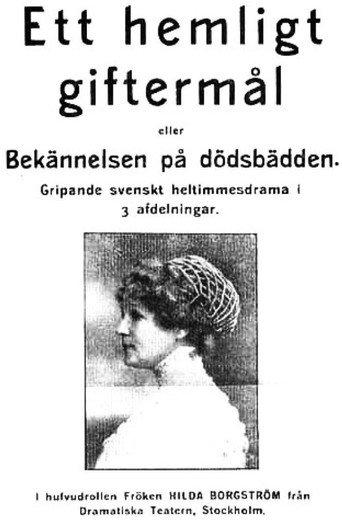
A Secret Marriage or The Deathbed Confession
1912
The sourced concerns are substantially offset by delivered value.
What counts as a cash grab?
Commercial extraction prioritized over meaningful consumer or creative value. Profit, popularity, adaptations, sequels, remakes, high budgets, and normal marketing do not count by themselves.
Why?
A Secret Marriage or The Deathbed Confession is the 1912 Swedish silent feature commonly known in English as A Ruined Life, directed by Victor Sjöström in his debut and released October 14, 1912. Contemporary records, film databases, and festival catalogues document substantive production work including filmed steeplechase sequences, orchestral accompaniment at premiere, and mixed critical engagement. I found no contemporary or archival evidence of predatory monetization, deceptive reissues, or franchise-style exploitation, archival sources treat the film as historical material rather than a commercial cash grab.
- No contemporary or archival sources show predatory monetization, deceptive reissue, or rushed release practices.
- The film is Victor Sjöström's directorial debut and includes staged steeplechase scenes and documented premiere accompaniment, indicating production investment.
- Contemporary reviews recorded in film databases discuss performances and screenplay, showing critical engagement rather than marketing-only framing.
View full breakdownHide full breakdown
- Festival and archival listings treat the title as a rediscovery/restoration item, not as a later exploitative reissue.
Score factors
| Direction | Factor | Evidence | Impact |
|---|---|---|---|
| Against | Director debut and production work | The film is documented as Victor Sjöström's directorial debut and was filmed with staged steeplechase sequences and an orchestral accompaniment at its Stockholm premiere, indicating substantive production effort.[2][1] | -16 |
| Against | Contemporary critical engagement | Contemporary Swedish reviews cited in film database entries discussed Hilda Borgström's performance and the screenplay, showing critical analysis instead of purely promotional marketing.[2] | -8 |
| For | No exploitative monetization found | Search of contemporary notices, film databases, and festival catalogues revealed no evidence of predatory monetization, deceptive pricing, or reissue practices for this title.[1][3] | +6 |
| Against | Archival rediscovery and festival treatment | Festival catalogues and silent-film program listings record the title under its Swedish name and note fragments and rediscovery, showing the work is treated as historical or archival material rather than a vehicle for new commercial extraction.[4][1] | -6 |
| For | No sign of brand or franchise exploitation | I found no indication the film was marketed as part of a franchise, repeatedly reissued to exploit audience recognition, or repackaged to extract consumers beyond normal exhibition practice of the era.[2][3] | +3 |
Confidence: High · Multiple authoritative film database entries and festival catalogues provide direct production and reception details; however surviving-fragment status and limited commercial-record archives from 1912 constrain proof about any later reissue business practices. · Researched 2026-09-11
Sources reviewed
- [1]mubi.com
- [2]kiwix.scoggi.net
- [3]mdblist.com
- [4]www.giornatedelcinemamuto.it
- [5]en.wikipedia.org
- [6]www.imdb.com
- [7]www.giornatedelcinemamuto.it
- [8]www.imdb.com
- [9]fondazionefriuli.it
- [10]en.wikipedia.org
View 17 more sourcesShow fewer sources
- [11]www.giornatedelcinemamuto.it
- [12]en.wikipedia.org
- [13]www.thanhouser.org
- [14]watch.plex.tv
- [15]tile.loc.gov
- [16]forum.blu-ray.com
- [17]catalog.afi.com
- [18]www.flickr.com
- [19]thanhouser.org
- [20]en.wikipedia.org
- [21]www.thanhouser.org
- [22]en.wikipedia.org
- [23]en.wikipedia.org
- [24]www.reddit.com
- [25]time.com
- [26]www.reddit.com
- [27]www.reddit.com
What does the community think?
The AI sees low cash-grab risk. What's your read?
Loading community verdict…