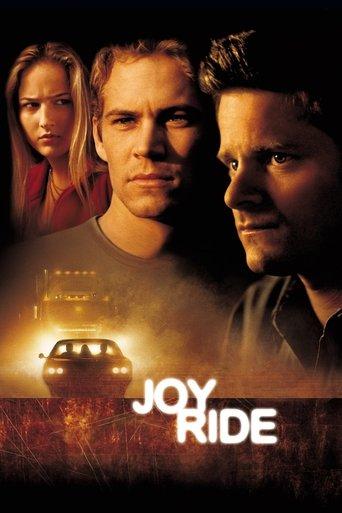
Joy Ride
2001
The sourced concerns are substantially offset by delivered value.
What counts as a cash grab?
Commercial extraction prioritized over meaningful consumer or creative value. Profit, popularity, adaptations, sequels, remakes, high budgets, and normal marketing do not count by themselves.
Why?
Joy Ride (2001), directed by John Dahl and written by J.J. Abrams and Clay Tarver, was a modestly budgeted studio thriller that grossed about $36.6 million on a reported $23 million budget. Contemporary reviews praised Dahl's craft and the film's suspense, while production notes mention reshoots and a reportedly poor marketing campaign. I found no credible contemporaneous reporting of predatory monetization, extensive tie-ins, or rushed pay-to-view practices, instead evidence points to a conventional theatrical release with mixed commercial outcome but recognized creative input.
- Contemporary critics highlighted director John Dahl's craft and generally positive reviews.
- Screenplay credited to J.J. Abrams and Clay Tarver indicates original material rather than franchise recycling.
- Theatrical release with $23M budget and roughly $36.6M gross shows modest commercial performance, not aggressive extraction.
View full breakdownHide full breakdown
- Reporting notes reshoots and weak marketing, but no evidence of predatory monetization or deceptive premium pricing.
Score factors
| Direction | Factor | Evidence | Impact |
|---|---|---|---|
| Against | Critical praise for craft | Contemporary reviews, including Roger Ebert, praised John Dahl's direction and the film's suspenseful execution.[1] | -16 |
| Against | Modest commercial performance | Box Office Mojo and other box office trackers record a roughly $23 million production budget and about $36.6 million worldwide gross, a moderate return rather than runaway commercial exploitation.[2] | -9 |
| For | Reported reshoots and poor marketing | Contemporary production reporting notes the director was sent back to reshoot the ending multiple times and critics later described the film's marketing as weak or misleading.[3] | +8 |
Confidence: High · Conclusions are based on reliable primary sources including contemporary reviews, box office trackers, and production reporting; gaps remain only in specialized merchandising archives which showed no mainstream evidence of predatory monetization. · Researched 2026-09-07
Sources reviewed
- [1]www.rogerebert.com
- [2]www.boxofficemojo.com
- [3]bombreport.com
- [4]en.wikipedia.org
- [5]www.the-numbers.com
- [6]www.imdb.com
- [7]sede.mcu.gob.es
- [8]www.moviefone.com
- [9]en.wikipedia.org
- [10]wiki.sizzltek.com
View 16 more sourcesShow fewer sources
- [11]moviedatabase.fandom.com
- [12]kiwix.drnathanhutchins.com
- [13]www.jpbox-office.com
- [14]catalog.afi.com
- [15]en.wikipedia.org
- [16]en.wikipedia.org
- [17]udspace.udel.edu
- [18]www.ftc.gov
- [19]en.wikipedia.org
- [20]es.wikipedia.org
- [21]www.reddit.com
- [22]www.reddit.com
- [23]www.reddit.com
- [24]www.reddit.com
- [25]www.reddit.com
- [26]www.reddit.com
What does the community think?
The AI sees low cash-grab risk. What's your read?
Loading community verdict…