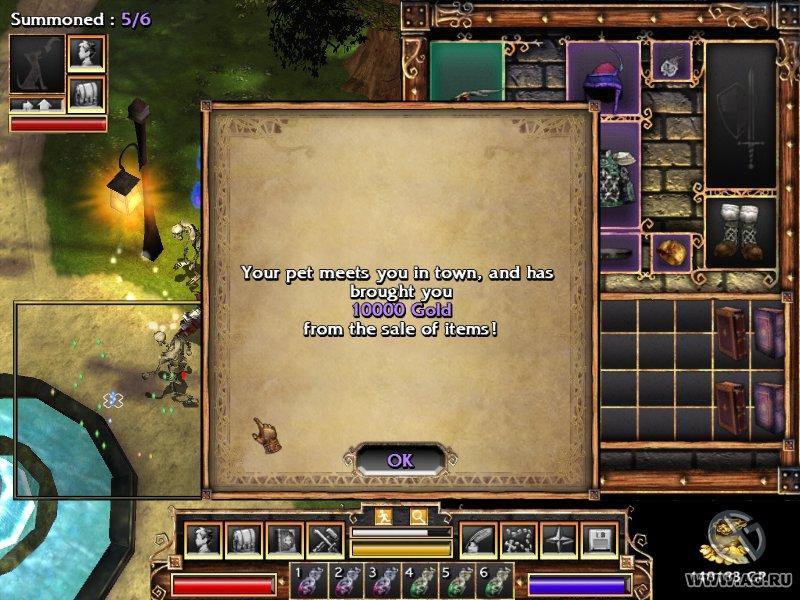
Fate (2005)
2005
The sourced concerns are substantially offset by delivered value.
What counts as a cash grab?
Commercial extraction prioritized over meaningful consumer or creative value. Profit, popularity, adaptations, sequels, remakes, high budgets, and normal marketing do not count by themselves.
Why?
Fate (2005) was released by WildTangent as a paid PC action RPG and received positive contemporary coverage for its addictive gameplay, presentation, and systems. Professional reviews and database entries describe it as a well-made Diablo-style dungeon crawler rather than a minimal or deceptive product. I found evidence of standard paid distribution via WildTangent and anecdotal OEM/demo experiences, but no sourced documentation of predatory microtransactions, deceptive launch tactics, or a rushed low-effort original release that would meet the definition of a cash grab.
- Contemporary professional reviews praised gameplay and production, indicating substantive consumer value.
- The game was distributed as a paid WildTangent download, typical for mid 2000s PC titles, but sources do not show predatory pricing or microtransactions for the 2005 release.
- Database entries and publisher pages describe real content features such as town hub, character progression, voicework and expansions.
View full breakdownHide full breakdown
- Later follow-ups were sometimes characterized as light extensions, which is an extraction signal for sequels but does not itself prove the original was exploitative.
Score factors
| Direction | Factor | Evidence | Impact |
|---|---|---|---|
| Against | Contemporary critical praise | Major outlets gave Fate positive reviews praising its charm, addictive gameplay and solid execution despite derivative influences.[2][4] | -15 |
| For | Distribution and pricing | Fate was originally published by WildTangent and sold as a paid download, contemporary user reports and storefront notes reference a roughly $20 purchase model for the original release.[1][5] | +13 |
| Against | Substantive game systems | Reference sources describe concrete features such as a town hub, character progression, persistent descendant characters, music and voicework, supporting substantive gameplay value.[3][1] | -13 |
| For | Light sequel/expansion critiques | Follow-up releases like Fate: Undiscovered Realms were described by outlets as standalone expansions with only a few new features, a critique that can signal low-effort reuse in subsequent monetization.[6] | +10 |
| Against | No reported in-game predatory transactions | Reviews and reference pages consulted for the 2005 release do not report any microtransactions, recurring fees, or pay-to-win mechanics in the original game.[2][3] | -9 |
| Against | WildTangent launcher and OEM/demo context | Contemporary and retrospective accounts note the WildTangent launcher and OEM/demo presence for the series, which created trial-to-purchase flows for some players but is not documented as predatory for the original 2005 release.[7] | -5 |
Confidence: High · Multiple contemporaneous professional reviews, publisher pages, and database entries were consulted and consistently show substantive gameplay and no documented predatory monetization for the 2005 release, though internal publisher financial records were not available. · Researched 2026-08-24
Sources reviewed
- [1]www.wildtangent.com
- [2]www.gamespot.com
- [3]www.mobygames.com
- [4]www.rpgfan.com
- [5]gamefaqs.gamespot.com
- [6]en.wikipedia.org
- [7]mydpad.com
- [8]www.gamespot.com
- [9]www.gamespot.com
- [10]gamefaqs.gamespot.com
View 19 more sourcesShow fewer sources
- [11]gamefaqs.gamespot.com
- [12]rpgcodex.net
- [13]games.tiscali.cz
- [14]en.wikipedia.org
- [15]www.reddit.com
- [16]www.reddit.com
- [17]www.reddit.com
- [18]www.reddit.com
- [19]www.reddit.com
- [20]games.wildtangent.com
- [21]www.reddit.com
- [22]www.reddit.com
- [23]www.reddit.com
- [24]www.reddit.com
- [25]www.reddit.com
- [26]www.reddit.com
- [27]www.reddit.com
- [28]de.wikipedia.org
- [29]cdn.akamai.steamstatic.com
What does the community think?
The AI sees low cash-grab risk. What's your read?
Loading community verdict…